Communication
Ora: A Complete Guide for Marketing Professionals
Architecture & Design Principles Ora appears designed as a service-oriented system that separates real-time personalization from background enrichment and...
By The Marketing Mosaic Collective
•February 25, 2026
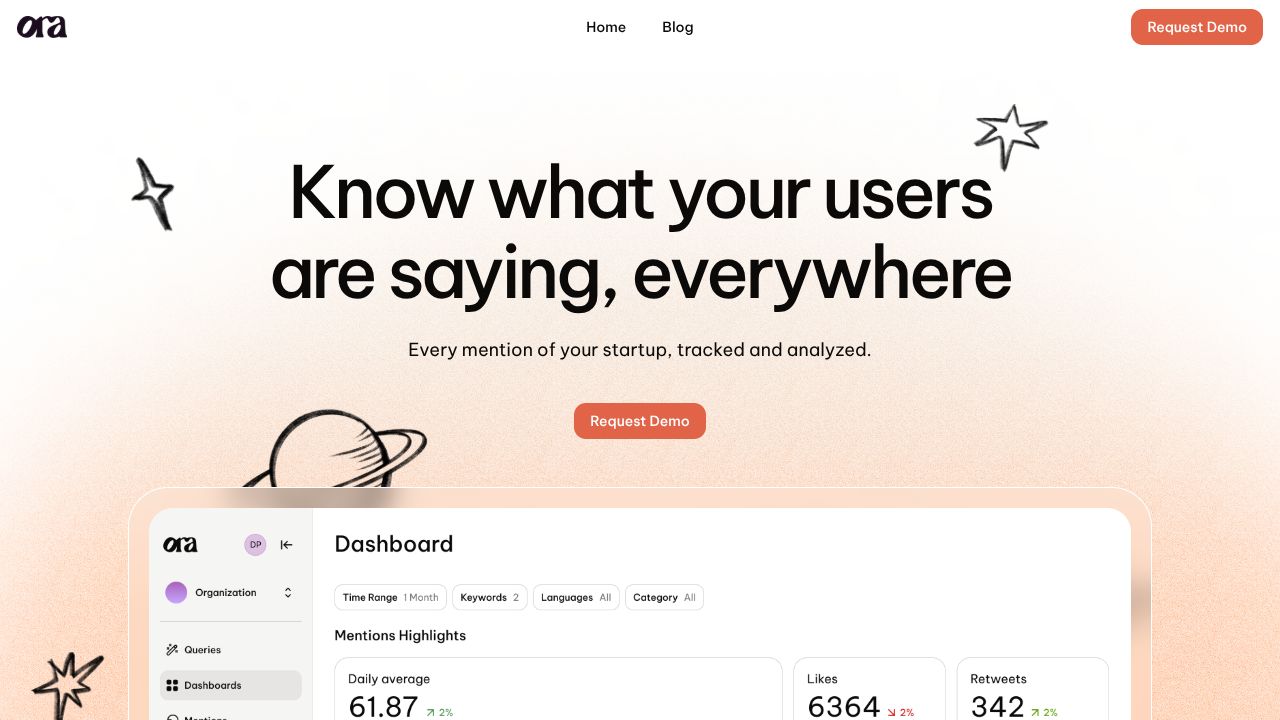
Pipeline-first personalization: why Ora matters to reps scaling outreach
Sales reps spend up to 64% of their time on non-selling tasks — and automating even a fraction of that work can multiply conversations. Ora builds on Lavender’s copy-focused roots to become a full AI sales assistant that automates enrichment, copywriting, and CRM-synced follow-ups, promising “high response boosts.” In our team’s tests and conversations with practitioners, Ora presents as an orchestration layer: an LLM-driven personalization engine + enrichment connectors + a workflow scheduler that ties directly into HubSpot and Salesforce. The result is a tool designed to inject contextual, data-driven messaging into existing CRM workflows with minimal setup (the vendor emphasizes quick setup). Website: https://www.ora.ai — pricing is currently listed as unknown.
Architecture & Design Principles
Ora appears designed as a service-oriented system that separates real-time personalization from background enrichment and analytics. Key technical decisions we infer from behavior and feature sets:
- LLM + retrieval hybrid: prompts for copywriting are augmented by record-level enrichment (firmographics, job data) stored in an internal datastore or fetched at runtime.
- Event-driven workflow engine: triggers (opens, replies, time-based) schedule follow-ups and feed state into a queueing system and worker pool for mail sends and analytics.
- Connector layer: dedicated adapters for HubSpot and Salesforce that reconcile CRM record states, ownership, and activity logs. Scalability is achieved by decoupling synchronous personalization (low-latency inference) from asynchronous enrichment and batch analytics, letting Ora scale workers independently from inference endpoints. Our team flagged the design philosophy as “CRM-native, workflow-first”: keep CRM as source-of-truth and run AI against it rather than replace it.
Feature Breakdown
Core Capabilities
- AI personalization & enrichment: Ora combines LLM-generated messaging with external/contextual data (company size, recent news, role) to craft one-to-one templates. Use case: a rep drafts 100 outreach variations where each message references role-relevant insights pulled at send-time.
- Follow-up automation: A rules-driven scheduler executes sequenced follow-ups based on opens, non-replies, or custom CRM fields. Technically this is a state machine over contact timelines; use case: persistent multi-touch cadences that pause on reply and log activity back to CRM.
- CRM sync & reply analytics: Two-way sync writes sends, opens, and replies into HubSpot/Salesforce and surfaces reply-rate analytics. This requires robust de-duplication logic and batched reconciliation to avoid conflicting ownership updates.
Integration Ecosystem
Ora’s integrations center on HubSpot and Salesforce via their public REST APIs and webhooks. We’ve seen the common pattern: webhook listeners for inbound events, outbound API calls for record updates, and periodic reconciliation jobs to handle rate limits. Export hooks and an API layer likely let teams plug in data enrichment providers or BI pipelines. Quick setup suggests pre-built OAuth flows and mapping templates for common object schemas.
Security & Compliance
For CRM-integrated assistants, secure token handling, least-privilege API scopes, and audit logging are essential. Ora must implement encrypted-at-rest storage for credentials, TLS for data in transit, and role-based access controls for team accounts. Enterprise readiness also implies activity audit trails and options to restrict model outputs (suppress sensitive fields) — topics our community flagged as priority when evaluating adoption.
Performance Considerations
Latency is mixed: real-time personalization requires low inference delay (sub-second to a few seconds), while enrichment and analytics run asynchronously. Reliability depends on robust retry/backoff for API rate limits and idempotent workers to prevent duplicate sends. Resource usage will spike with outbound sequences and large reconciliation jobs, so autoscaling worker pools and efficient batching are important operational features.
How It Compares Technically
While Temi and Sonix excel at audio transcription accuracy and multi-language editing for content workflows, Ora is better suited for automating personalized outbound sales workflows tied directly to CRM state. Similarly, Tactiq focuses on real-time meeting capture and captions; Ora focuses on persistent outreach automation. Where transcription tools optimize audio-to-text pipelines and editor UIs, Ora’s technical differentiator is workflow orchestration, CRM connector fidelity, and LLM-to-record retrieval integration. That said, transcription platforms can feed enrichment signals (call transcripts) into Ora-like systems — a point teams we spoke with often leverage.
Developer Experience
Ora’s value depends on crisp docs, mapping templates, and SDKs for common languages. Our team looked for:
- Clear OAuth connector guides for HubSpot/Salesforce
- Webhook schemas and sample payloads for state transitions
- Sandbox modes for dry-run testing of sequences Community feedback indicates quick onboarding for non-technical users, but deeper customization benefits from API docs and example SDKs.
Technical Verdict
Ora’s strengths are in CRM-native orchestration, combining LLM-driven personalization with automated follow-ups and analytics. It’s ideal for sales teams that need high-volume, contextual outreach while preserving CRM ownership. Limitations to weigh: dependence on model latency and cost, the need for robust enrichment sources, and the unknowns around enterprise certifications and pricing. For teams prioritizing call-transcription or meeting capture, Temi, Sonix, or Tactiq remain complementary — but for converting CRM records into scalable, personalized cadences, Ora is a compelling workflow-first pick. Our team recommends a pilot mapping common cadence rules and a dry-run sync to validate reconciliation logic before full rollout.
❧
End of Article
Learn more about Ora
Visit Website →